Ocean observations are essential for understanding and predicting our changing planet. The Global Ocean Observing System (GOOS) and European research infrastructures rely on a diverse network of observing platforms, including profiling floats, drifting buoys, gliders, moorings, research vessels, and animal-borne sensors. While this diversity enables global coverage and innovation, it also creates challenges for coordination, interoperability, and long-term traceability because different organisations use different metadata standards. Furthermore, observations from a variety of other sources – such as regulatory monitoring of water quality and good environmental status in coastal areas, or citizen science observations of invasive species – are critical sources of information and make these challenges even more complex.
To address these challenges, AMRIT has supported the development of GOOS Passports, implemented by OceanOPS, the GOOS operations monitoring and support centre. A GOOS Passport is a harmonised, minimum metadata record that provides each observing element (often called platform) with a trusted, structured identity. Rather than replacing existing network-specific metadata systems, the GOOS passport provides a common metadata layer that enables information to be shared consistently across observing networks and communities.
The GOOS Passport also supports integration with the WMO Integrated Global Observing System (WIGOS) by providing the metadata required for registration and visibility in OSCAR/Surface, the WMO global registry that centralizes metadata and unique WIGOS identifiers for all surface-based Earth-observing stations. This strengthens links between deep ocean, ocean atmosphere interface and atmospheric observing communities while improving the consistency and discoverability of ocean observations.
The Passport metadata model is intentionally simple
At the core of every GOOS Passport is a persistent identifier based on the WIGOS Station Identifier (WSI) framework. These identifiers are allocated by OceanOPS on behalf of GOOS and WMO, providing a stable and globally recognised identity for observing platforms throughout their operational lifetime.
The Passport metadata model is intentionally simple, covering six key areas: identification, affiliation, operations, hardware, data channels, and operational status. This minimum metadata approach lowers barriers to participation while ensuring that essential information is captured consistently. Passports issued to each observing platform comply with existing standards and can be generated from current network metadata or through automated interfaces, supporting efficient metadata exchange and machine-to-machine interoperability.
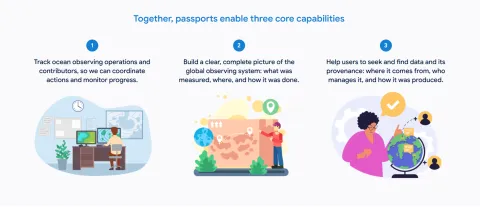
By improving the visibility, traceability, and discoverability of ocean observing platforms, GOOS Passports help create a more connected and coordinated global observing system without imposing a single metadata model on diverse communities. They are being developed collaboratively with international observing networks, European ocean observing community and private sector partners, with further enhancements for coastal and regional observing systems, including citizen observations, supported through AMRIT.
Within AMRIT, the GOOS Passport offers many other benefits.The attributes of the GOOS Passport are essential for managing the vast metadata tree required to describe the various value chains of ocean observation data in a uniform manner. First and foremost, the AMRIT project is driving innovation in marine data management by adopting the GOOS Passport as the structural backbone for its entire IT development.
Empowering operators to deliver critical metadata
By developing dedicated tools, AMRIT empowers operators to seamlessly deliver critical metadata across the full lifecycle of their observing platforms. To validate its robustness, the project is testing the passport on diverse coastal and national networks, or citizen observation not yet part of the GOOS networks. One of the key steps in AMRIT involves linking this passport to an automated alert system, thereby ensuring transparency for coastal states and operators monitoring observation operations. Finally, the GOOS Passport interfaces with other existing concepts and standards (management of research vessel campaigns by other systems such as marine facility planning, sensor management, etc.) as well as with other information systems such as the Digital Platform for Ocean Observation developed by the EC for member states.
As ocean observing continues to grow in scale, complexity, and societal importance, harmonised approaches to metadata and persistent identification will become increasingly essential. The ability to issue the GOOS Passport to as many platforms as possible will be a decisive step towards more integrated and interoperable European and global ocean observation systems.